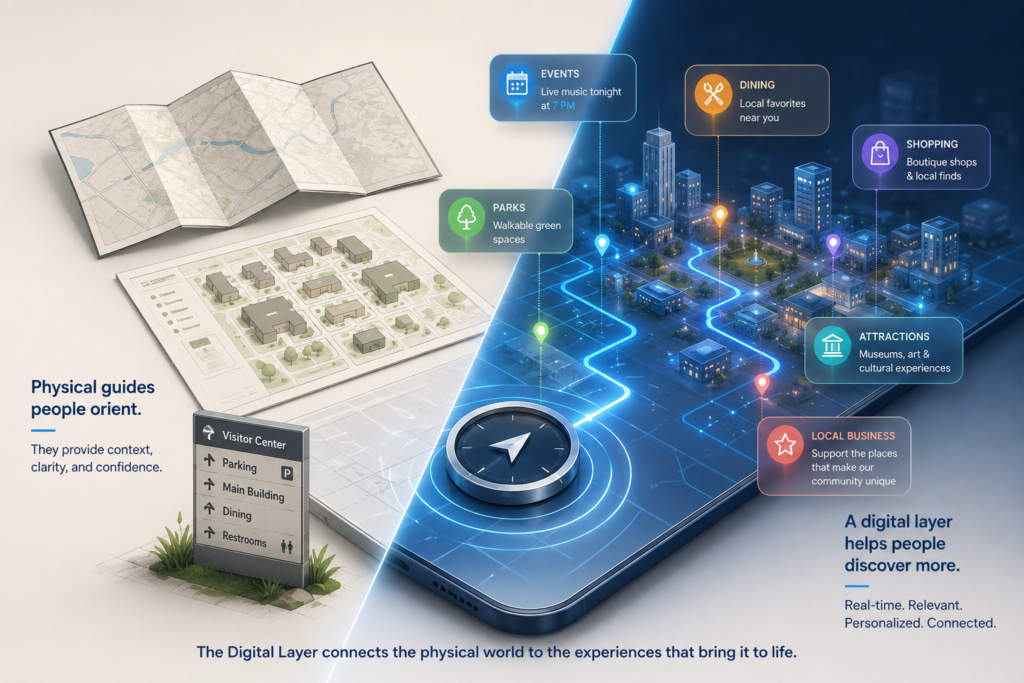
For years, the conversation around smart cities has focused on technology.
Connected traffic signals. Intelligent transportation systems. Public Wi-Fi. Environmental sensors. Artificial intelligence. Data analytics.
These innovations are helping cities operate more efficiently, reduce congestion, improve sustainability, and deliver better public services. They are making cities smarter from an operational perspective.
But what if we’ve been asking the wrong question?
Instead of asking, “How can technology make cities smarter?” perhaps we should also be asking:
“How can technology help people experience cities better?”
Imagine arriving in a city you’ve never visited before.
You’ve just checked into your hotel. Your conference doesn’t begin until tomorrow morning. You have the evening free to explore.
You ask yourself a few simple questions.
Where should I eat?
What’s happening nearby tonight?
Is there a local coffee shop within walking distance?
What makes this city unique?
Where do the locals go?
These are some of the most common questions travelers ask, yet they’re often the hardest to answer—not because the information doesn’t exist, but because it’s scattered across dozens of websites, apps, brochures, social media pages, and printed materials.
The city may be smart.
But the visitor experience is often fragmented.
The Missing Layer
Every city already has a digital presence.
Community calendars.
Hotel recommendation lists.
Visitor guides.
Business directories.
Transit information.
Interactive maps.
The challenge isn’t a lack of information.
The challenge is that the information exists in pieces.
Every physical place already has a digital layer. Sometimes it’s a paper map. Sometimes it’s a PDF. Sometimes it’s a hotel recommendation sheet or a visitor guide. We believe that layer should be connected, dynamic, and designed around how people actually experience places.
Discovery Is Different Than Information
For decades, we’ve focused on giving people information.
Information answers the question:
“What exists?”
Discovery answers a different question:
“What should I experience next?”
That’s an important distinction.
A visitor doesn’t want to sort through hundreds of restaurants after leaving a conference.
They want to discover the local restaurant everyone recommends.
A family visiting a university doesn’t want a list of every building on campus.
They want to know where to park, where to eat, and what experiences they shouldn’t miss during Family Weekend.
A tourist doesn’t simply want directions.
They want to discover what makes a destination memorable.
Technology shouldn’t just organize information.
It should help people discover experiences.
A Missed Opportunity
Cities invest millions of dollars attracting visitors.
They compete to host conferences, sporting events, festivals, concerts, conventions, and cultural celebrations because visitors fuel local economies.
But what happens after those visitors arrive?
A conference attendee leaves the convention center.
Within a five-minute walk are locally owned restaurants, independent coffee shops, public art, live music venues, and small businesses that help define the city’s character.
Instead, they follow the crowd to the nearest chain restaurant attached to the hotel—not because it’s the best choice, but because it’s the easiest one to find.
That represents a missed opportunity.
Not only for visitors.
But for local businesses.
For neighborhoods.
For destination marketing organizations.
And for the city itself.
Helping visitors discover more of a community isn’t just good for the visitor experience.
It’s good for economic development.
The Next Evolution of Smart Cities
For years, we’ve measured smart cities by how efficiently they move vehicles, manage utilities, and collect data.
Those investments matter.
But perhaps it’s time we also measured them by how well they help people experience the places they visit.
Imagine conference attendees discovering locally owned restaurants after the final session ends.
Imagine parents attending Family Weekend exploring nearby businesses before heading home.
Imagine tourists finding neighborhood experiences they otherwise would have missed.
Imagine local businesses becoming part of every visitor’s journey—not by chance, but by design.
That’s not simply better technology.
It’s a better experience.
The Bhlen Perspective
At Bhlen, we believe every physical place has a digital layer waiting to be unlocked.
Hotels, universities, conferences, destinations, downtown districts, airports, parks, and communities all invest in creating memorable experiences. We believe technology should make those experiences easier to discover, navigate, and engage with—not replace them.
Through research, partnerships, and real-world implementation, we’re exploring how digital layers can strengthen visitor experiences, support local businesses, and help organizations connect people with everything a place has to offer.
Because when people arrive somewhere new, finding their destination is only the beginning.
Discovering everything around them is what transforms a visit into an experience.